

Growing our business while lowering the pressure to the environment

Lowering carbon intensity
We are committed to reducing the carbon intensity of our operations and are constantly developing our abilities and systems accordingly.
Greenhouse Gas (GHG)
We have already for few years calculated our Greenhouse gas emissions and are working continuously to improve the used data. Still at this point most of our calculations are made with generic emission factors but we are working to increase the proportion of better-quality emission data.
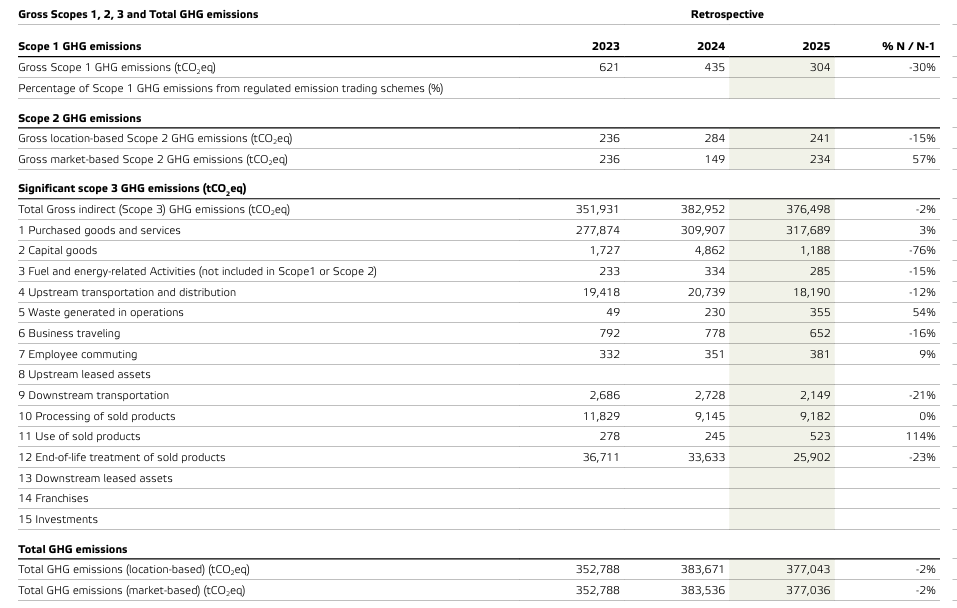
Our total emissions in 2025 were 377,043 tCO2 e. As we operate as a raw material distributor, the share of Scope 3 emissions in total emissions is very high – more than 99%. Approximately 84% of total emissions come from purchased goods and services (category 1), with products accounting for almost 98%.
Scope 3 category 4 (emissions from transportation of purchased goods) accounted for 5 percent, and category 9 (emissions from outbound transportation) accounted for 0.6 percent of Telko's total emissions. Estimates have been used to calculate emissions from the transportation of both purchased and sold products. Other emissions, including commuting and waste, have a minor impact on total emissions.
Scope 1 and Scope 2 accounted for only about 0.2% of Telko’s total emissions in 2025. They consist of the fuel and energy consumed by the company’s owned and leased cars, as well as the energy consumption of facilities.
The largest environmental impact of our business stems from Scope 3 emissions across our value chain rather than from our direct operations. Addressing these emissions involves optimizing logistics flows, utilizing low-emission transport, and offering low-emission solutions and products to our customers.
Although our Scope 1 and 2 emissions are significantly lower than our Scope 3 emissions, we work also on minimizing them. In many of our facilities, we partially use green energy, our company car policy mandates low-emission vehicles, and our subsidiary, Optimol, has installed rooftop solar panels for office and warehouse energy needs. Swed Handling, another subsidiary involved in goods transportation, optimizes transport schedules to achieve environmentally friendly, high-occupancy deliveries.
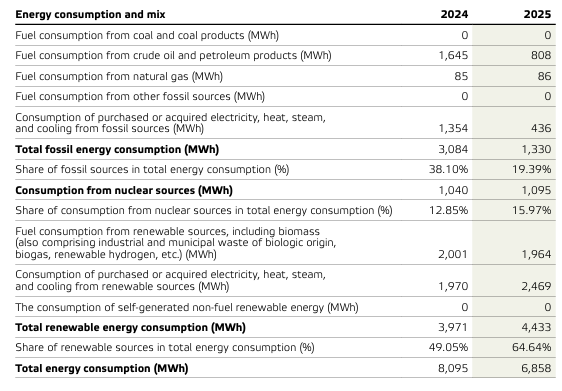
Energy consumption
Telko transports and logistics optimization
- Since June 2024, all packaged goods in Finland have been transported exclusively using biodiesel, reducing greenhouse gas emissions by nearly 90% compared to the previously used fossil fuels. Swed Handling trucks as well are using biodiesel.
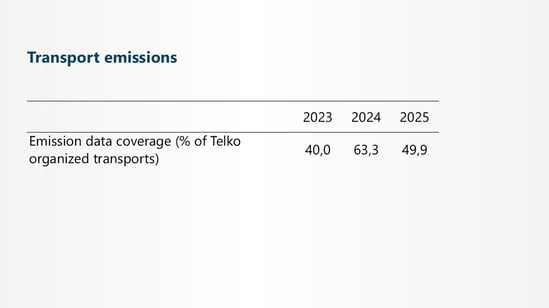
- During past few years we have been able to get emission data concerning our transports followingly:
CO2 Footprint Data:
-
- From 2025 we have had a tool in place to share the emission data of the purchased products and outbound transports to our customers.
- We work constantly to improve our emission calculating tools and the quality of used emission data.
Improving recycling and waste management
Our organization is committed to minimize the waste generated in our operations. The major waste fractions are the raw material waste from our all operations and process water waste from Swed Handling production. All this waste is handled as hazardous waste. As the relative amount of raw material waste is very low the amount may vary from year to year quite much. In 2025 the waste amount raised compared to the previous years mainly due to the discontinuation of certain business activities and the resulting need to responsibly manage remaining inventories.
The amount of chemical waste generated in our operations:
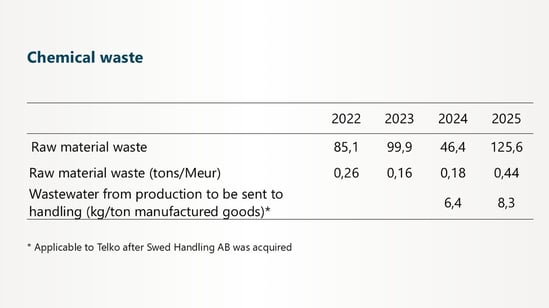
At our chemical terminal in Finland, we manage significant quantities of organic solvents. As a result of these operations, we generate VOC (volatile organic compound) emissions that have constantly been under 2000 kg/year.
For all packaging operations, we assess the availability of recycled materials that can be used without compromising safety, quality, or risk of generating additional waste.
The quantity of recycled raw materials sold is included in the figures provided in the next section.
Driving sustainable innovations
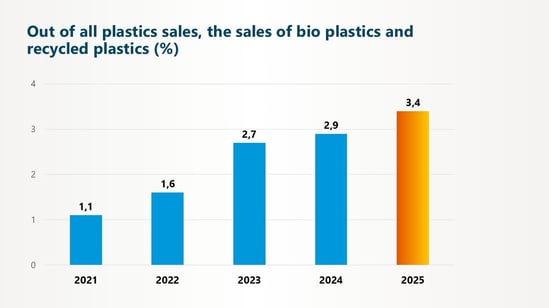
Our plastics segment has been actively promoting the sales of sustainable product for several years, and the sales of sustainable plastics have consistently increased. While we are still in the early stages quantitatively, the trend is very encouraging.
Related


Improving the Telko experience for people in our value chain
Ensuring employee safety
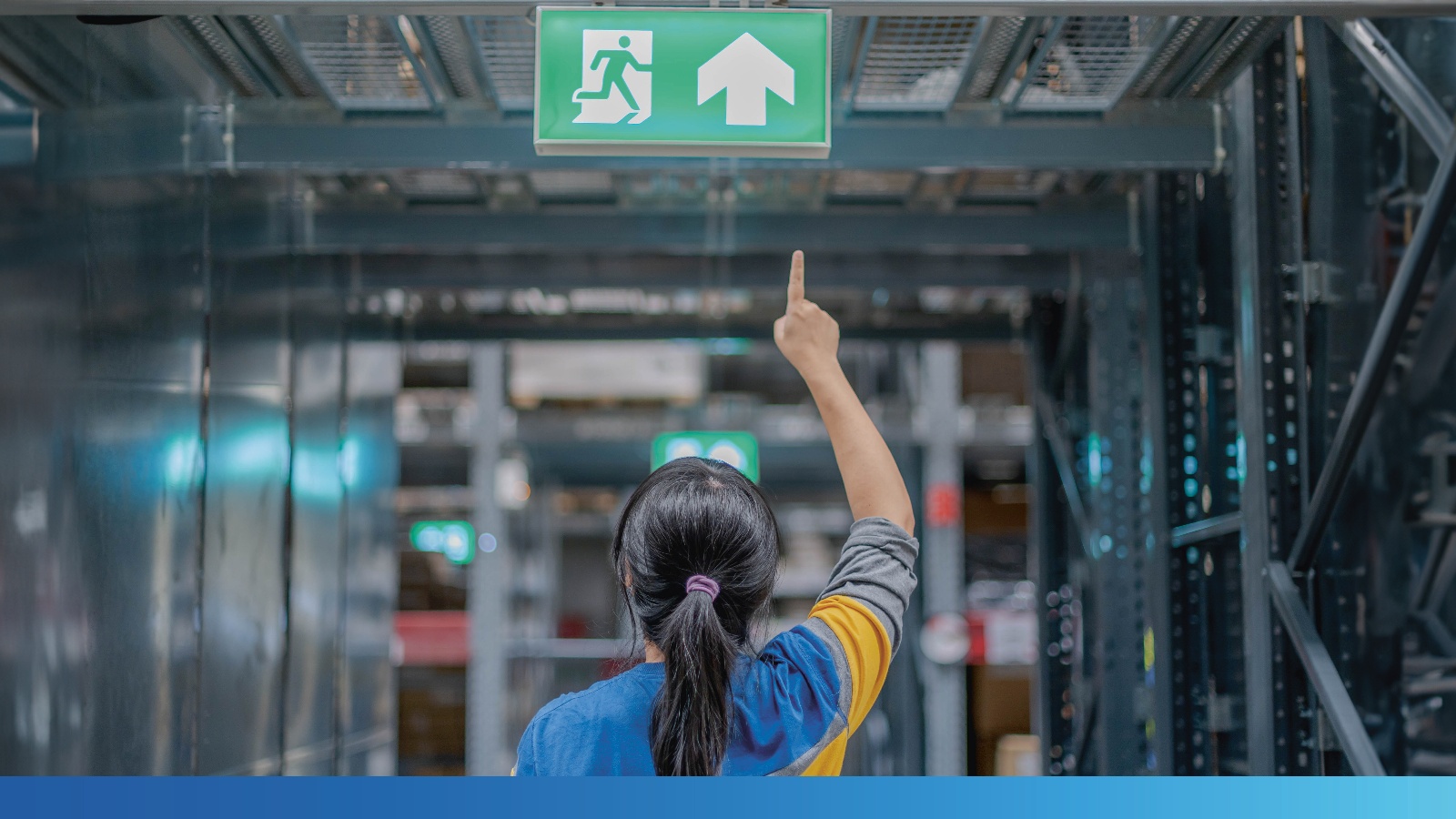
The safety and wellbeing of our employees is a top priority. We are committed to continuously strengthening our safety culture and creating a workplace where everyone can work safely and confidently every day.
Our Safety Culture Improvement Programme has progressed according to plan throughout 2025 and the first half of 2026, supporting the development of safer behaviours, stronger safety awareness, and proactive risk management across the organisation. The safety metrics below illustrate our ongoing journey and performance.
When comparing safety performance over time, it is important to note that our business profile changed significantly in 2024 following the acquisition of Swed Handling, a major production company. This expanded our manufacturing operations and increased the number of employees working in production environments, which naturally affected our safety statistics.
Today, we are working together across all business units to continuously improve workplace safety, prevent incidents, and build a strong safety culture where everyone takes responsibility for their own safety and the safety of their colleagues.
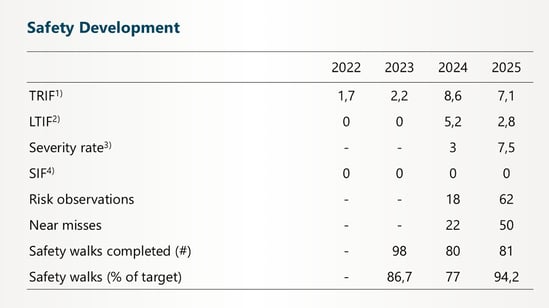
1) Injuries that require medical treatment and/or alternative work per million person-hours
2) Injuries resulting in absence at least one full day per million person-hours
3) Avarage days lost per incident
4) Number of Serious Injuries & Fatalities
Improving the employee experience
Employee engagement survey
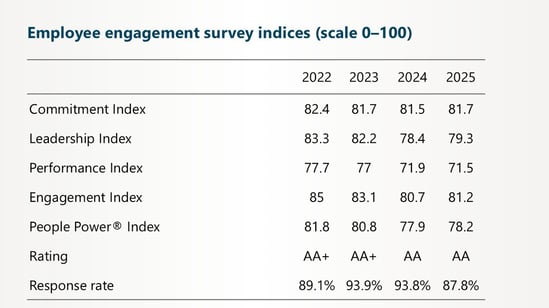
We continuously monitor employee engagement and workplace satisfaction through regular employee surveys, helping us identify strengths and areas for further development. The results below show the survey outcomes from 2022 onwards, when we introduced a consistent survey methodology that enables year-on-year comparison.
The impact of several acquisitions completed during 2024 is reflected in the results. Integrating new businesses, teams, and organisational cultures naturally influenced employee experience during this period and contributed to a temporary decline in some survey indicators. Despite these changes, we remain committed to fostering an inclusive, engaging, and supportive work environment, and we continue to work actively to enhance the employee experience across the entire organisation.
Improving the customer and principal experience
To further develop our operations, we measure how well we are serving our customers. In 2025, our customer Net Promoter Score (NPS) was 48.
Telko have hired university students for summer and part time during winter to give them the opportunity to get professional experience during their studies.
Related

Driving sound governance practices at all levels

Sound governance
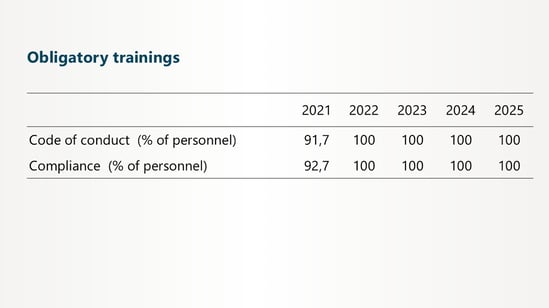
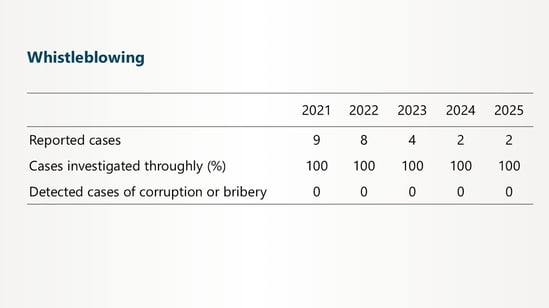
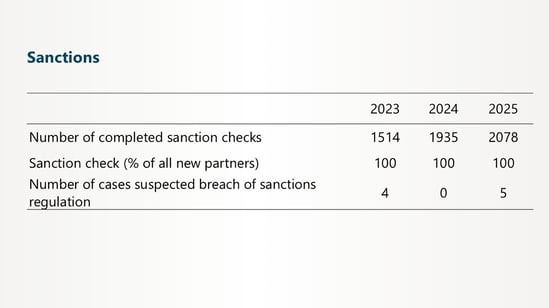
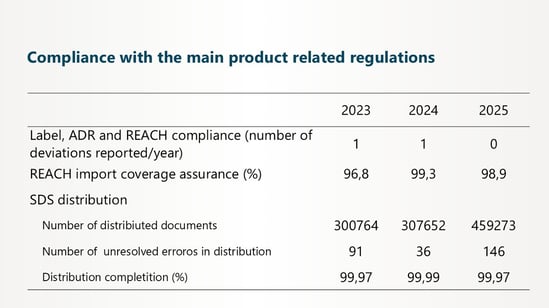
In 2025, we reached the target of completed annual Code of Conduct and Compliance trainings. The compliance training includes, inter alia, anti-corruption, anti-bribery, and anti-competitive themes. We also continued improving our compliance work with process developments and automation including internal controls, quality, and environmental management system and the systematic risk management process. Below are the basic compliance metrics from past years.
- In 2026 risk assessment was reviewed three times, and mitigation plans were updated accordingly.
- Execution status of risk mitigation plans was monitored in 2025 four times, and more frequently in the identified risks which has required closer attention to.
Sustainable value chain
We have successfully completed a pilot project to assess the sustainability risks of our suppliers using an AI-based tool. This assessment included 100 of our largest product suppliers, covering approximately 94% of the products purchased.
The AI tool performed automatic scoring and risk analysis based on industry and country-specific risks in areas such as labor rights, political unrest, health and safety, human rights, environmental impact, governance, consumer unrest, and strategic development. As a result, we obtained a comprehensive 360° risk score for each supplier, reflecting also aspects like the regulatory environment. The suppliers were positioned in a risk matrix shown below, with the impact factor represented on one axis and the risk score on the other. The tool also displayed the risk score trend over the past two years for each supplier.
The assessment revealed a generally low risk level among our suppliers, with only four suppliers placed in the high- or mid-priority areas of the risk matrix. We conducted an in-depth review of these four suppliers to better understand their actual risk levels.
- The supplier in the high-priority area had an low score only in the environmental category. However, the AI tool found no specific alerts for this supplier, and their score trend was stable. Additionally, the supplier's certifications and policies indicated active engagement with environmental issues.
- Of the two mid-priority suppliers, no alerts were found, and their certifications and policies demonstrated that they were addressing their weaker areas.
- For the third mid-priority supplier, both positive and negative alerts were found online. Historical data showed that this supplier had a very good overall sustainability risk score a year prior, which then suddenly dropped, followed by a gradual and continuous improvement.
We concluded that there is no immediate sustainability risk with these suppliers that would require actions. We will continue to monitor their risk levels closely.
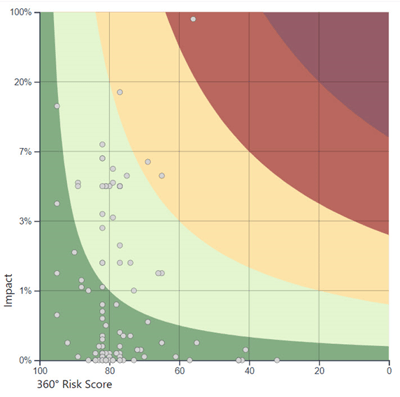
The risk matrix of the 100 largest product suppliers covering approximately 94% of our purchases.
In 2026 we are building a comprehensive supplier management process to assess our suppliers regularly not only from sustainability perspective but also from other angles.
Product Compliance – Palm Oil
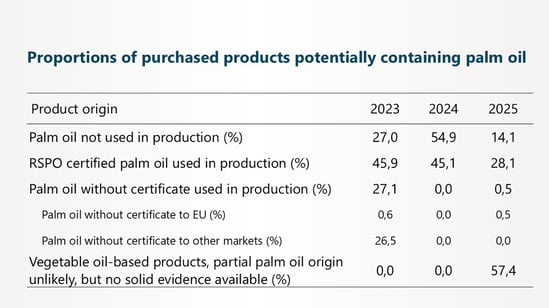
We have prepared a few years to comply with the upcoming EU deforestation regulation. As part of this process, we have conducted a thorough review of our product portfolio to identify any potentially affected products and implemented necessary controls to ensure future compliance. Additionally we actively communicate with our suppliers to verify the origin of all potentially affected products purchased. where applicable, we are working diligently to obtain traceability information for palm oil-based products down to the plantation level. Our daughter company, Swed Handling AB, is a registered distributor member of the RSPO.
Continuous development of our sustainability program
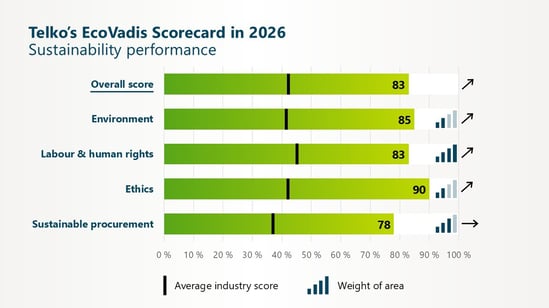
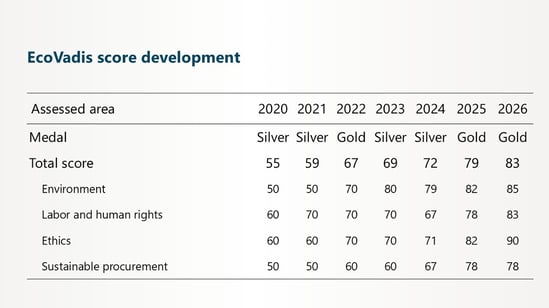
We have chosen the EcoVadis sustainability assessment as the objective measure of our sustainability progress. We participate in the assessment annually and have consistently improved our score since 2020.